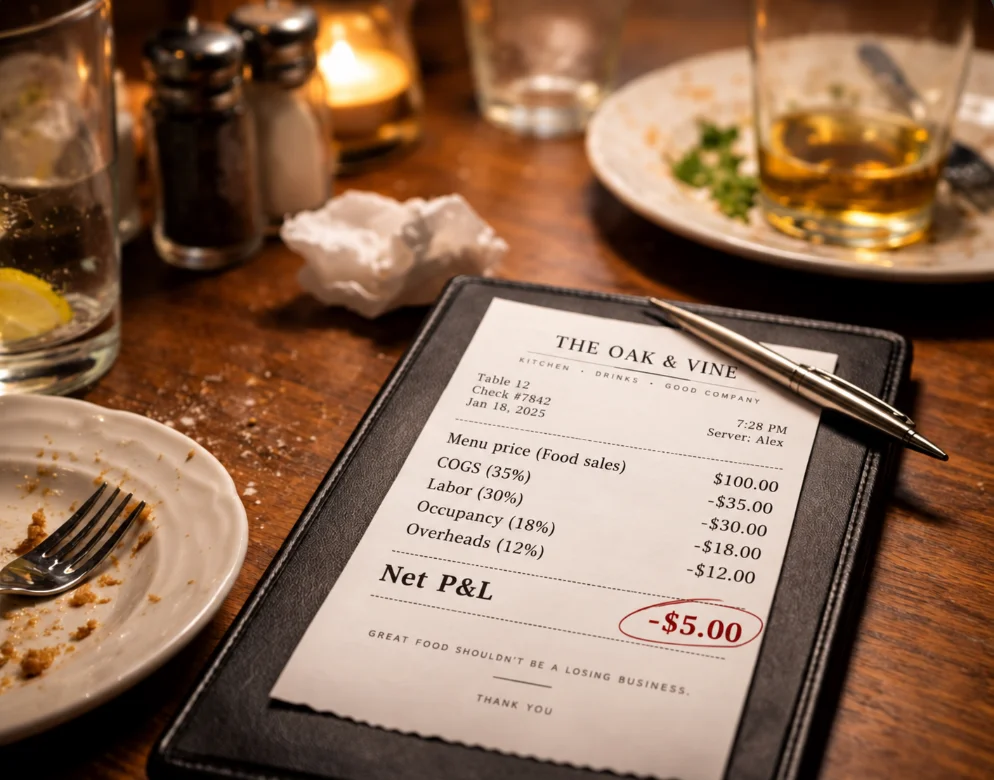
Walk into almost any kitchen office and ask how a dish was priced, and you'll hear the same answer: we costed the recipe, applied the target food cost, rounded up. Thirty per cent, thirty-two, twenty-eight: the number varies, the method doesn't. It's called cost-plus, and it feels responsible. It isn't. It's pricing from the wrong end.
What cost-plus actually protects
Cost-plus protects the margin on each dish in isolation. It does nothing for the number that pays the rent: spend per head. A guest doesn't buy a dish at 30 per cent food cost. They buy a meal (a starter they may or may not order, a main, something to drink, perhaps dessert) and they leave a cheque. If every item is priced to defend its own margin, the cheque is an accident.
Worse, cost-plus punishes the dishes you most want to sell. A well-sourced fish with an honest cost lands at a price that scares the table; a bowl of pasta with a 14 per cent cost is a bargain that everyone orders and nobody remembers. The menu ends up selling what's cheap to make, not what the venue is for.
Start from the cheque
The right end to start from is the guest's cheque. Decide, honestly, what a table of two should spend here on a Tuesday and on a Saturday. That number is a positioning decision before it is a financial one. It says who the venue is for. Then work backwards: how many courses, at what price points, produce that cheque without the guest feeling pushed?
Once the cheque is fixed, the menu becomes architecture. Anchors that set the ceiling. Volume items priced to move. Two or three dishes where the margin is deliberately thin because they define the place. The food cost target then applies to the menu as a whole, a blended 30 per cent across what actually sells, rather than to every line.
What this looks like on the floor
A menu built backwards is shorter, because every dish has a job. It reads differently, because prices sit in a deliberate range rather than scattering wherever the recipe cost landed. And it changes how the team sells: when the architecture is right, a server recommending the fish isn't upselling, they're pointing at the reason the guest came.
The measure is simple. Spend per head against the target you set, every week. If it drifts, the fix is almost never a price rise on one dish. It's the mix, and the mix is the menu doing, or not doing, its job.